Tell me when it’s out
One email on publication day, with where to find the book. Nothing before, nothing after.
The book
In 1902, Lieutenant Caleb Friedman of the Office of Naval Intelligence arrives at the Pensacola Navy Yard to reconcile a discrepancy in the ordnance receipts. He finds a corridor already running — powder and fittings moving through the harbor on paper that balances — and he finds a lighthouse family across the water who set a place for him at the table. He sees almost enough. He signs. He waits. In January 1906 an explosion at the yard kills sixteen-year-old Eli Pittman, the keeper’s ward, and in the September hurricane that follows, Caleb Friedman is listed missing, presumed dead.
Six years later a man named Amos Wade takes the second assistant’s post at the Pensacola Lighthouse. He keeps the light for nineteen years. Nobody asks.
In the present day, Dr. Elliott Harper, a maritime archaeologist at the University of West Florida, stands under the tower on Lighthouse Day and cannot make the keeper’s photograph resolve — a scar, a jaw, a way of standing. A concreted iron mass from a Fort McRee survey, x-rayed, shows a clasp knife with three initials on the bolster. The reader knows from the first page who the keeper was. Elliott has to earn it, through federal archives, a dead investigator’s private papers, a cemetery on the bluff, and finally his own family — on the Army side of the harbor, not the keeper’s — and the record stops exactly one document short of proof.
At home, Heather has stopped expecting an answer to when he’ll be back, and Owen has a playoff game at two. The question the book asks of Caleb — how long is too long to wait to do the right thing — it asks of Elliott in a kitchen, with the dishwasher running.
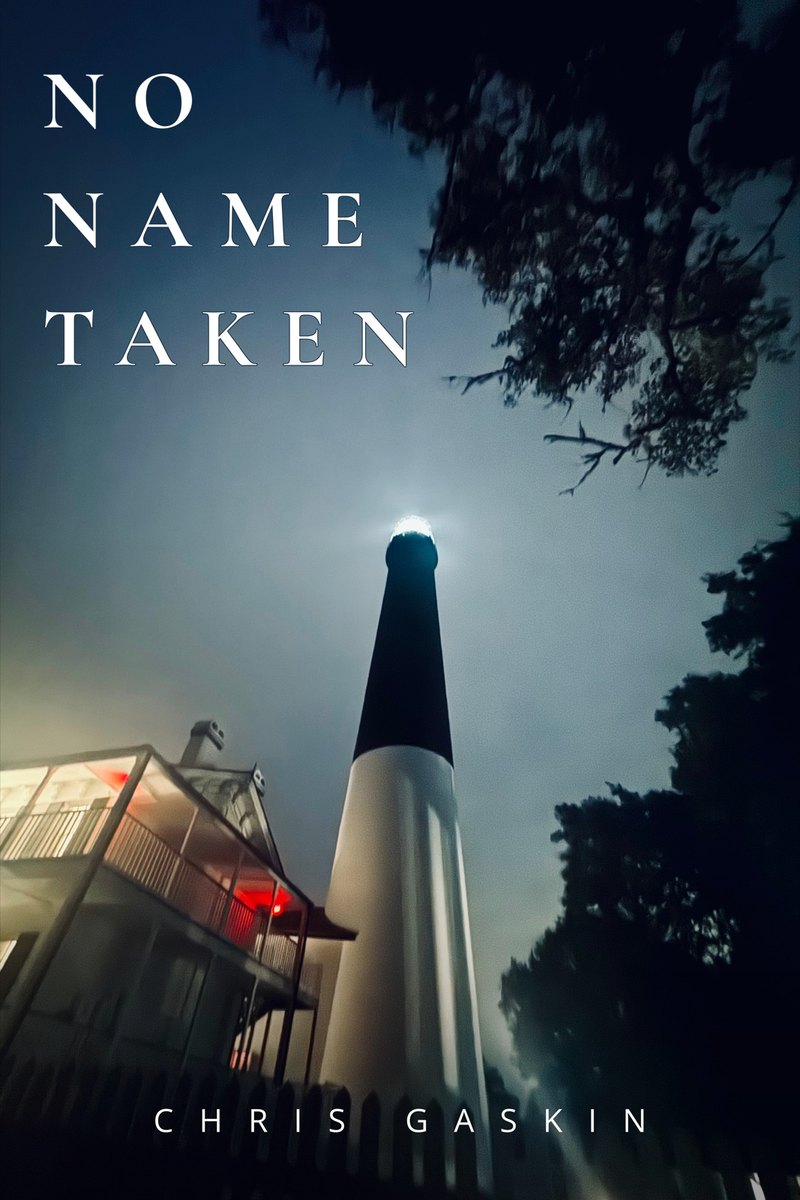
No Name Taken is a novel about the difference between a record and the truth, and about the people who live in the gap between them. Its answer is a lighthouse that is still standing.
The opening
The prologue, and the first chapter.
Prologue
Pensacola Lighthouse — August 1912
The August heat on the Gulf was a weight before it was a temperature. That was the first thing he remembered.
Heavy.
Thick.
The kind of air that made sweat pointless.
Six years gone. Six years of Amos. Caleb didn’t have the decency to go with him.
The oyster shells crunching under his feet were the same shells. That was what he hadn’t prepared for. Not the tower — he had seen it from the water and made himself look until looking stopped meaning anything. Not the smell, not the light on the pass. The shells. The specific, chalky rasp of it.
He had walked this path before.
Amos Wade had not.
The wind came off the water and brought the Gulf up with it — salt first, then under it the rot of sargassum baking on the shore. Six years in New Orleans had taught him a different smell: the river’s own rot, mud-deep, everything the Mississippi dragged down from everywhere else. He had learned that one.
This was older in him.
A hot gust hit him broadside and snapped the linen shirt flat to his chest. His suspenders drew taut, the straps biting into his shoulders. He ducked into it. The wind whistled past his ears and worked through the coarse thicket of his mutton chops.
He stopped under the live oak.
August here. He had forgotten August here.
The canopy shifted overhead, slow, the whole mass of it moving as one.
He looked up at the tower, then walked to the gate. The same gate he’d opened a thousand times before. Without ceremony.
He stood in front of it and let his head drop.
Then —
Caleb’s hand opened the gate.
Amos closed it.
Chapter One
Pensacola Lighthouse — April — Present Day
The light always felt older than the stories.
Not the tower. Not the brick. Not the 177 steps spiraling into the dark.
Something quieter than that. Something that had outlasted the Civil War cannons and the yellow fever cycles.
The watching.
The lens was still turning — automated now, no keeper climbing with oil and cloth and breath — and the place still held it. As if the attention had soaked in. Into the walls. Into the iron. Into the glass.
Dr. Elliott Harper stood beneath the west side of the tower, a legal pad tucked under one arm and a lanyard around his neck that he’d already stopped wearing correctly. He still carried a pen. He liked the scratch of it.
The April wind hit hard off the water, flattening his jacket against him before letting go.
Behind him, Lighthouse Day was still assembling itself.
Volunteers nudged folding chairs into rows that wouldn’t stay straight. A portable speaker crackled, spat static, then surrendered entirely.
Near the gift shop, a woman in period dress was trying to keep three children from sword-fighting with souvenir flags.
She was losing.
Metal clanged somewhere behind the keeper’s quarters.
Someone laughed too loudly.
A folding table snapped open sharp enough to startle half a dozen people.
The Gulf ignored all of it. Elliott ignored most of it.
He looked back at the tower.
White. Weathered. Unapologetic.
“Elliott.”
Sandy Carlisle was coming toward him with a stack of laminated placards and the strained look of someone doing six things at once.
“One more look at the keeper timeline?” she asked. “I just want another set of eyes.”
Elliott pulled his glasses from his pocket and offered them to her. “You want another set of my eyes.”
Sandy didn’t take them. “That too.”
He took the stack.
KEEPERS OF THE LIGHT: 1859–1937. Sepia portraits. Short paragraphs. Dignified. Compressed.
“I’ll take another pass,” he said.
“You’re a gift.”
“No one means that when they say it.”
“Today I do.”
She was gone before he could answer, leaving him alone with the placards. The wind caught the edges of the laminate and set them chattering against each other.
Elliott set the placards on a bench and started from the top. Dates. Names. Service gaps. Transfers. A lens replaced in one decade but not another. A restoration date that had drifted by three years because someone once used the wrong newspaper clipping and nobody after had bothered to check it.
He turned the pages slowly.
Two keepers. Three. Four.
Then he stopped where he always stopped.
AMOS WADE. Appointed 1912. Served until 1931. Remembered for his steadfast service, his storm discipline, and his role in preserving continuity at the station through years of coastal change and post-hurricane recovery.
The words were smooth. Polished.
The photograph was smaller than the others, set into the placard without emphasis. Same sepia. The same careful language beneath it.
He had already turned past it once. He turned back.
A child ran past him, close enough that he felt the air move. The boy carried one of the lighthouse keeper toys from the gift shop, the cardboard backing nearly as large as his torso. A miniature lantern, a pocket watch, and a tiny logbook sat sealed beside the figure beneath clear plastic.
“Don’t drop it,” someone called.
“I won’t,” the boy said, not slowing.
Elliott didn’t turn. He leaned slightly and adjusted his glasses. At first it looked like nothing more than an uneven shadow beneath the beard line — the kind of distortion old photographs picked up over time. He had seen it before. Dismissed it before.
He shifted again, just enough to test it. The line of the jaw didn’t run clean. It broke slightly beneath the beard. Not enough to register at a glance. Once seen, it would not smooth back into place.
He let his eyes adjust to it rather than correcting the image.
The scar was what kept pulling him back. Not because it was dramatic. Because it wasn’t.
He set the placard down and reached into the leather satchel at his feet. From an inner folder he slid out a photocopy — a Naval Academy class photograph, Annapolis, 1896, the Lucky Bag page worn at the edges from being unfolded too many times. He had pulled it from the archive earlier in the week.
The paper was soft now from handling.
He held the two images side by side.
The younger man wore the uniform differently. More formally. Less at ease in it. The face was fuller, the eyes clearer, the shoulders held higher, as if the posture had not yet been negotiated.
The name sat beneath the image in the archive copy, still legible despite the wear.
Caleb Friedman.
No official connection to the lighthouse at all. At least none that had ever held.
Elliott let his eyes move between the two images without forcing them to line up. The years alone accounted for most of the difference. Men changed. Faces settled. Weight shifted.
Not the scar. Not yet.
The angle of the head, slightly off center.
Then the mouth.
Not the shape of it. The set of it — a tension at one corner, held rather than shown.
Something contained.
It wasn’t enough.
It wasn’t anything yet.
But it wasn’t nothing.
“You’re working.”
He looked up too quickly.
Nora Talbot, who ran programs and events for the lighthouse, stood several feet away with coffee in one hand and a rolled program in the other.
“You sound surprised.”
“I’m disappointed in your commitment to atmosphere,” she said. “You should be staring dramatically at the Gulf while children eat commemorative cookies.”
“I’m waiting for the children to stop touching nineteenth-century things with modern frosting hands.”
“Reasonable.”
She nodded toward the images in his hand. “You found another typo?”
“Not sure yet.”
“That usually means yes.”
He slid the photocopy halfway back into the satchel. “Maybe just a resemblance.”
“To what?”
Silence.
“To a photograph I pulled from the Naval Academy archive. Probably nothing.”
“This for the post-war chapter?”
“It is.”
“Mm.”
A pause.
“What kind of nothing?”
“The kind that either disappears if I look at it another hour,” he said, “or gets worse.”
“That seems healthy.”
“That’s usually how I end up in another archive.”
Nora sipped her coffee, considering him a moment too long.
“Sandy said you were going to sign off on the timeline.”
“I will.”
“You know today is supposed to be the easy part.”
“I know.”
“Try to let it be easy for ten minutes.”
“That has never once been my gift.”
She smiled once and moved off toward the chairs.
Elliott was already looking at the placards again.
Continue the story on February 9, 2027. Tell me when it’s out.
The author